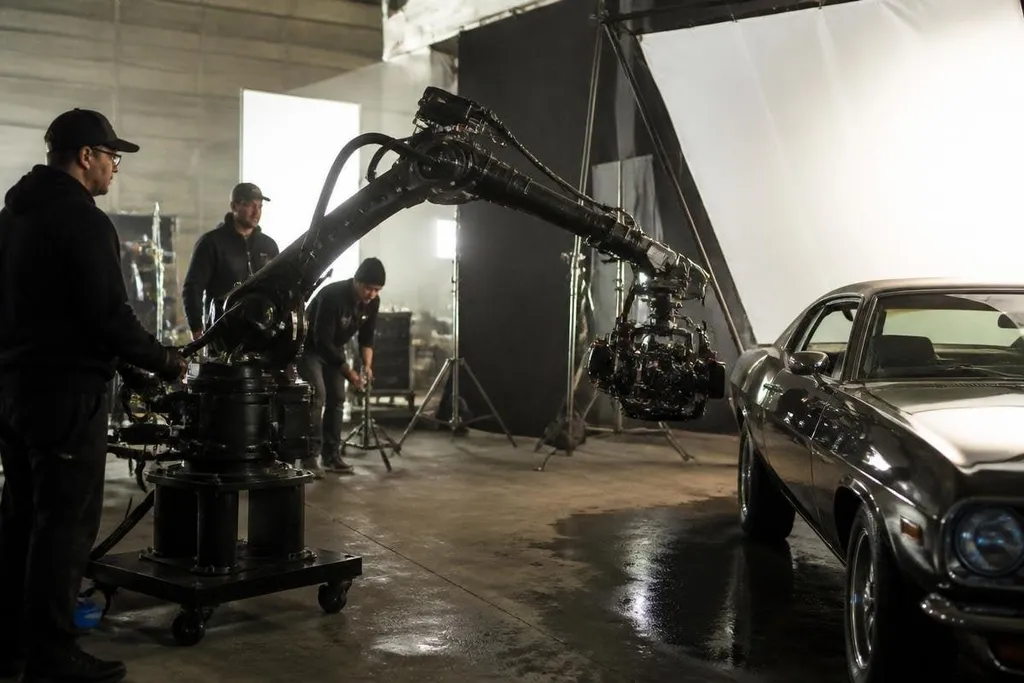
A film robot may need to repeat the same move for hours while lights, cameras, and people shift around it. AI can help plan those moves, read the set, and adjust actions, but it doesn’t remove the need for safe hardware or a skilled crew.
Quick read:
- AI can turn camera paths, actor marks, and robot motion into one planning problem.
- Vision systems help robots detect people, props, and changes between takes.
- Safety checks, repeatability, and production control still need clear limits.
Where AI fits on a film set
Traditional robot programming asks a technician to define each movement in advance. That works well for fixed tasks, but a film set changes between takes. A prop moves, an actor misses a mark, or a camera needs a new angle.
AI systems can process inputs such as camera footage, set maps, motion data, and spoken commands. The system then suggests or creates a movement plan for the robot. A technician still needs to check that plan before the robot runs it near people.
This matters most for robots used as camera platforms, moving props, or repeatable performers. The robot doesn’t need to guess what the director wants. It needs a clear target, a known space, and a way to stop when conditions change.
Camera work and repeatable motion
A robot arm or mobile platform can repeat a camera move more closely than a person can by hand. For a desired shot, the system can create a path with speed changes, pauses, and limits around people or equipment.
The useful part is repeatability. If an actor needs another take, the robot can return to the same position and follow the same motion plan. That gives the camera team a stable starting point for editing and visual effects.
The same system can help match robot motion to an actor’s movement. A vision system may track body position from camera input, then send updated targets to the robot. The result depends on lighting, clothing, occlusion, and the delay between image capture and robot movement.
Those limits matter. A system that reacts late can move a camera into the wrong place, even if the planned path looked correct on a screen.
Robots that handle changing sets
Film sets contain cables, stands, rails, props, and people who may cross a robot’s path. A robot using cameras or LiDAR can build a map of nearby objects and check that map as the work area changes.
The practical benefit is less manual reprogramming between takes. The robot can compare its planned route with the current space and stop when an object blocks the route.
That does not make the robot safe by itself. It adds another layer of detection to a system that still needs physical limits and an emergency stop.
A camera arm that can stop near a person still needs proof from a real set. Robot24.com film robotics reporting can tie claims about AI control to the task, operator role, and test conditions before producers plan an automated camera move.
The same tools can help with previsualization. A production team can test a camera move in a digital model before placing equipment on the set. That can expose reach, clearance, or timing problems while the plan is still easy to change.
What AI still can’t fix
AI does not make a robot’s motors stronger, its brakes faster, or its body lighter. It also cannot make an unsafe layout acceptable. Those limits come from hardware, control software, crew training, and the rules used on the production.
There is another problem: film work rewards exact timing, while AI systems often produce outputs that need checking. A movement that looks correct in a preview may fail when a cable shifts or a person enters the frame.
The best use is supervised automation. The crew sets the boundaries, reviews the plan, runs a controlled take, and keeps a person ready to stop the robot. Fully hands-off operation near actors should remain an unproven claim unless a production can show how it handles failure.
A practical planning checklist
Before putting an AI-controlled robot on a set, check these points:
- Define the task: Set the exact camera move, prop action, or repeated motion the robot must perform.
- Map the space: Record walls, stands, cables, actor marks, and areas the robot must not enter.
- Set human limits: Decide how close the robot may work to actors and crew, then add physical speed and force limits.
- Test failure cases: Check what happens when vision is blocked, a route changes, or communication stops.
- Keep manual control: Give a trained operator a clear view, a direct stop control, and authority over every take.
AI is most useful on a film set when it reduces repeated programming without hiding the robot’s limits. I’d approve it first for controlled camera moves and digital planning, then expand its role only after the crew has recorded safe, repeatable takes.
The next useful question for any production is specific: which task needs flexible robot control, and what happens when the system gets it wrong?